The Albertina in Vienna, Austria is a museum known for it
outstanding collection of works on paper.
The Albertina maintains a large collection of watercolors, drawings and
prints by the Northern Renaissance master Albrecht Durer (1471-1528). This past spring the Albertina lent this vast
and impressive collection to the National Gallery of Art in Washington, DC.
 Self-portrait by Albrecht Durer, 1500, oil painting.

Durer is known in the history of art for his intense
self-portraits, thought by many scholars to be the first self-portraits ever created.
Indeed what scholars believe is the first self portrait made by an artist is in
the exhibition. It is a small detailed
silverpoint drawing completed by Durer when he was just 13 years old. (For more information about the silverpoint
technique see my blog posting:mariedauenheimer.blogspot.com/.../silverpoint-drawing-history-and.html)
 Self-portrait by Albrecht Durer, 1484, silverpoint on prepared paper.

In 1505 Durer travelled to Venice and developed one of his
most elegant drawing techniques.Using a
medium blue Venetian paper (made from blue rags) Durer drew with white gouache
and dark ink to create luminous, chiaroscuro drawings.
 The Head of an Angel by Albrecht Durer, 1506, brush and ink with wash, heightened with white on blue paper.

When Durer traveled back to Germany he did not take this
Venetian paper with him, but started making his own paper prepared with a
ground, usually blue, but sometimes green and gray. This is how Durer made one of his most icon
drawings “The Praying Hands”. The
drawing was created in 1508 as a study for an altarpiece for a Frankfurt
church (which burned down in 1724). The drawing was done as a part
of a larger study of one of the apostles. The drawing was later cut down and made into two separate drawings. (see below).
 Praying Hands by Albrecht Durer, 1508, brush and wash, heightened with white on blue prepared paper.

Durer introduced many important artistic traditions to his
Northern European colleagues. His use of
linear perspective, masterfully complex woodcuts and engravings transformed
printmaking. Durer’s treatises on human anatomy and proportion transformed the
way artists depicted the figure. Finally, like Leonardo, Durer was
fascinated with the overlap of science and art.
 Male Nude by Albrecht Durer, 1513, pen and brown ink on paper.

Indeed in Durer’s sublime watercolor “The Great Piece of
Turf” (1503) his art “creates a balance between scientific observation and
artistic poetry”.
 The Great Piece of Turf by Albrecht Durer, 1503, watercolor and gouache on paper.

In 1514 Durer experienced a personal crisis when his mother
died. During his mourning he created his
“master prints” about despair and death. They include his print of St. Jerome for which he did his magnificent
study.
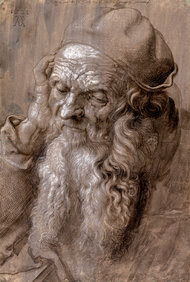 An Elderly Man of Ninety-Three Years by Albrecht Durer, 1521, brush and ink, heightened with white on gray-violet prepared paper.

The National Gallery of Art exhibits closed in June. However
I highly recommend the superb catalog published by the National Gallery of Art.It is called "Albrecht Durer, Master Drawings, Watercolors and prints from the Albertina" by Andrew Robison and Klaus Albrecht Schroder.


