Showing posts with label drawing. Show all posts

Tuesday, September 3, 2013

Albrecht Durer: Master Drawings, Watercolors and Prints from the Albertina


The Albertina in Vienna, Austria is a museum known for it outstanding collection of works on paper.  The Albertina maintains a large collection of watercolors, drawings and prints by the Northern Renaissance master Albrecht Durer (1471-1528). This past spring the Albertina lent this vast and impressive collection to the National Gallery of Art in Washington, DC.

                                Self-portrait by Albrecht Durer, 1500, oil painting.

Durer is known in the history of art for his intense self-portraits, thought by many scholars to be the first self-portraits ever created. Indeed what scholars believe is the first self portrait made by an artist is in the exhibition. It is  a small detailed silverpoint drawing completed by Durer when he was just 13 years old.  (For more information about the silverpoint technique see my blog posting:mariedauenheimer.blogspot.com/.../silverpoint-drawing-history-and.html‎)

                    Self-portrait by Albrecht Durer, 1484, silverpoint on prepared paper.

In 1505 Durer travelled to Venice and developed one of his most elegant drawing techniques.Using a medium blue Venetian paper (made from blue rags) Durer drew with white gouache and dark ink to create luminous, chiaroscuro drawings. 

The Head of an Angel by Albrecht Durer, 1506, brush and ink with wash, heightened with white on blue paper.

When Durer traveled back to Germany he did not take this Venetian paper with him, but started making his own paper prepared with a ground, usually blue, but sometimes green and gray. This is how Durer made one of his most icon drawings “The Praying Hands”. The drawing was created in 1508 as a study for an altarpiece for a Frankfurt church (which burned down in 1724). The drawing was done as a part of a larger study of one of the apostles. The drawing was later cut down and made into two separate drawings.  (see below).

Praying Hands by Albrecht Durer, 1508, brush and wash, heightened with white on blue prepared paper.

Durer introduced many important artistic traditions to his Northern European colleagues. His use of linear perspective, masterfully complex woodcuts and engravings transformed printmaking. Durer’s treatises on human anatomy and proportion transformed the way artists depicted the figure. Finally, like Leonardo, Durer was fascinated with the overlap of science and art.

                         Male Nude by Albrecht Durer, 1513, pen and brown ink on paper.

Indeed in Durer’s sublime watercolor “The Great Piece of Turf” (1503) his art “creates a balance between scientific observation and artistic poetry”.

The Great Piece of Turf  by Albrecht Durer, 1503, watercolor and gouache on paper.

In 1514 Durer experienced a personal crisis when his mother died. During his mourning he created his “master prints” about despair and death. They include his print of St. Jerome for which he did his magnificent study.
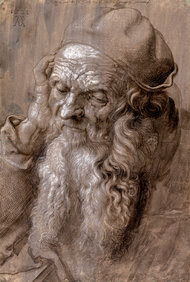
An Elderly Man of Ninety-Three Years by Albrecht Durer, 1521, brush and ink, heightened with white on gray-violet  prepared paper.

The National Gallery of Art exhibits closed in June. However I highly recommend the superb catalog published by the National Gallery of Art.It is called "Albrecht Durer, Master Drawings, Watercolors and prints from the Albertina" by Andrew Robison and Klaus Albrecht Schroder.


Monday, January 28, 2013

Drawing the Figure with Pen and Ink


I am taking a class at the Art League in Alexandria, Virginia with instructor Robert Liberace. Liberace is an accomplished painter, sculptor and draughtsman. The class, “Figure and Portrait: A Modern Approach to Classical Drawing”, explores drawing the figure through master techniques, such as silverpoint, pen and ink, charcoal, red chalk and graphite.  I hope to post on these various techniques in the coming weeks.

                             Robert Liberace, Figure Study in pen and ink, 2012.

The past two weeks we have been using pen and ink with watercolor washes to create a three dimensional drawing of the figure.  Pen and ink, using flexible nibs, allows the artist to create energetic, dynamic sketches. Rembrandt’s pen and ink drawings, characterized by his calligraphic line, are great examples of this technique.

          Rembrandt van Rijn Woman Having Her Hair Combed, pen and ink, 1637

Pen and ink can also be used for longer more detailed studies.  It was a favored medium of Michelangelo, Leonardo, Durer and many other masters. Liberace recommends using a slightly textured text weight paper such as Twinrocker in “Calligraphy Cream”.  To add warmth to the paper he coats it with a light watercolor wash using yellow ochre or raw sienna. Since pen and ink is an unforgiving medium (erasing is difficult if not impossible) most artists begin with a simple pencil sketch of their subject. 

                Michelangelo Buonarroti, Studies of the Holy Family, pen and ink, 1505.

When ready to start drawing Liberace recommends using a sepia ink, such as seen in master drawings, with flexible nibs. The nibs allow the artist to create lines that go from thick to line as pressure is put on the nib. Rob also uses Micron technical pens as he draws. Technical pens (which store their ink in the pen) allow for a more consistent line.

                        Marie Dauenheimer, Figure Study, pen and ink, 2013.

I highly recommend experimenting with his wonderful medium!


Monday, January 14, 2013

"Matisse, In Search of True Painting” at the Metropolitan Museum of Art


In 1949 art critic Clement Greenberg wrote of Matisse “A self assured master who can no more help painting well than breathing.”  Indeed when I look at Matisse’s paintings they show a confidence and bravado in the brushwork, colorful palette and composition.  It was surprising to learn that painting never came easy to Matisse who "reworked, questioned and repainted".

                Still Life with Compote, Apples and Oranges by Henri Matisse, 1899

The exhibition “Matisse: in Search of True Painting”, at the Metropolitan Museum of Art , explores how Matisse used his canvasses as tools, repeating compositions in order to "compare effect, gauge his progress" and “push further and deeper into true painting.”

By creating multiple paintings of the same subject matter Matisse experimented with different techniques to explore the subject.  He often copied the same image over and over varying the treatment of the canvas and handling of the paint.

In his series of paintings of the “Young Sailor” Matisse used graphite pencil to block in the figure, he followed with black paint to re-inforece the outline.  His final step was to use vivid paint, allowing it to drip and run, to emphasize the two dimensional aspect of the surface. 

                                     Young Sailor I by Henri Matisse, 1906

                                      Young Sailor II by Henri Matisse, 1906

A series of three canvasses of “Le Luxe” dominate the exhibition.  Influenced by Ingres and Cezanne, Matisse sought to convey the essential qualities of his figures.  Using various materials, such as charcoal, distemper (a water based medium with a matte surface like fresco) and oil, Matisse created a dramatic series of figure studies that work independently, but when together create a powerful series that echo the forms of the figures.

Three versions of Le Luxe by Henri Matisse, the first using charcoal, the second in oil and third using distemper, 1907-08

Another series of paintings by Matisse, highlighted in the exhibition, are of Notre Dame.  They are based on the view from his Paris apartment. “I never tire of it, for me it is always new”.  The series, as you can see moves from a traditional view of the cathedral to one that becomes more abstract.  These later paintings giving way and influencing a new generation of artists seeking “true painting”.

                                         Notre Dame by Henri Matisse, 1900

Notre Dame by Henri Matisse , 1941

                                        Notre Dame by Henri Matisse, 1914

I highly recommend this exhibition which is at the Metropolitan Museum of Art through March 17, 2013.  I also recommend the catalog edited by Dorthe Aagesen and Rebecca Rabinow.

Wednesday, January 2, 2013

Topics for 2013


Happy New Year!  As we begin the new year I have been brainstorming about blogging topics for 2013.  I was in New York for a few days and I plan on blogging about some amazing exhibitions I saw and plan on visiting.  Among them are the “Bernini, Sculpting in Clay” and “Matisse: True Painting” at the Metropolitan Museum of Art. 

Bernini's terracotta sculpture model for the "Lion on Four Rivers Fountain" 1649-50. From the  exhibition at the Metropolitan Museum of Art.


The “Beatrix Potter, The Picture Letters” and “Durer to de Kooning” exhibitions at the Morgan Library are worth discussion and exploration.  The Frick’s “Mantegna to Matisse, Master Drawings from the Courtauld Gallery” and MoMA’s “Inventing Abstraction” look fascinating.  The National Gallery of Art’s upcoming French drawing exhibition “Color, Line, Light: French Drawings, Watercolors, and Pastels from Delacroix to Signac” is much anticipated for it’s varied collection.

Pastel drawing by Auguste Louis Lepere, 1900.  From exhibition "Color, Line, Light: French Drawings from Delacroix to Signac" at the National Gallery of Art.


 I plan on continuing to blog about master drawing techniques , such as pen and ink and wash and red chalk.  As I prepare my 2014 Vesalius Trust“Art and Anatomy” tour to Greece and Italy I will continue to blog about Andreas Vesalius whose 500th anniversary is next year! To reflect the focus of my blog I have added "Art and Anatomy" to my title.

Pen and ink drawing by Jacques Bellange, 1610. From the "Durer to de Kooning" exhibition at the Morgan Library.


Thanks for reading, commenting and joining me on my art and anatomy travels! 

Sunday, December 9, 2012

Silverpoint Drawing, History and Technique


Silverpoint is a drawing technique with roots that go back to the time of the Renaissance.  The technique involves drawing on prepared paper with a small wire of silver sharpened to a point, much like a hard graphite pencil. As the stylus is dragged across the paper it leaves a mark of silver.  The layering of these hatched and crosshatched silver lines build up to create a soft value study. The technique is unique in that over time the drawing changes and becomes luminous as the silver tarnishes. 

         Leonardo Study of the Head of a Girl, 1483, silverpoint on brown prepared paper

Leonardo, Raphael and Durer are all Renaissance masters who experimented with silverpoint.  Durer’s father was a metal smith and likely introduced his young son to this technique. Silverpoint is a delicate, but somewhat unforgiving medium; but with some practice the results can be remarkable.  

                   Leonardo, Horse Studies, 1493, silverpoint on blue prepared paper

Contemporary artists using silverpoint begin the process, much as the Renaissance masters did, by preparing their paper with a ground.  The ground can be anything from house paint to commercially prepared grounds such as Golden’s Artists Supply “Silverpoint/ Drawing Ground”.  Watercolor can be added to the ground to create a toned surface. Using a rag paper the ground is applied with a brush and allowed to dry for at least 24 hours.

According to artist/author Juliette Aristides Lord Frederic Leighton worked on this rather large (21 x 15.5 inches) silverpoint drawing "from morning to evening for a full week".  

 Lord Frederic Leighton, Study of a Lemon Tree, 1858, silverpoint on white prepared paper

             Marie Dauenheimer, Portrait Study, 2010, silverpoint on white prepared paper

           Marie Dauenheimer, Figure Study, 2012, silverpoint on white prepared paper

             Marie Dauenheimer, Figure Study, 2012, silverpoint on white prepared paper

If you are interested in learning more about how to prepare paper for silverpoint and about this technique watch this instructional video from Golden (scroll down).

I highly recommend this technique!  It is enjoyable and the results can be brilliant!

Monday, August 1, 2011

Three Colored Crayon Technique Workshop with Robert Liberace, Studio Incamminati, Philadelphia, PA PART 1

This past weekend I spent three days at the Studio Incamminati in Philadelphia attending a workshop with Robert Liberace on the three colored crayon technique. The three colors are back, white and red (terra cotta).

This technique has been used for centuries by artists such as Hans Holbein, Peter Paul Rubens and Antoine Watteau. Below are some examples of how they used this technique.

artwork

"Young woman Looking Down" by Peter Paul Rubens, 1628.

Holbein

"Sir Thomas Elyot" by Hans Holbein, 1527.

In class Rob demonstrated two techniques for using the three crayons. I will review the first technique today and the second technique tomorrow.

photo.jpg

Three crayon technique drawing by Robert Liberace.

The first technique utilizes hard colored pencils (Prismacolor "Verithins" work well)
in black, white and terra cotta on a text weight hand made paper (Twinrocker is ideal). The paper is prepared with a light watercolor wash in yellow ochre and sealed with a coat of amber shellac (with denatured alcohol mixed in). This hardens the paper and gives it a tooth so you can layer the pencil.

Liberace 1

First stage of Rob's demo, with figure blocked in using terra cotta Verithin pencils.

Liberace 2

Second stage as Rob builds up the form using the terra cotta color and adds black.

Liberace3

The final stage as form is built up using terra cotta and black and white highlights are added. Highlights can also be erased out used a typewriter eraser.

marie drawing

Three crayon drawing by Marie Dauenheimer.

Thursday, December 23, 2010

Sketching at the Metropolitan Museum of Art

A few months ago I spent a day sketching at the Metropolitan Museum of Art. I spent most of the day in the Greek and Roman Galleries and it was wonderful. I plan on going back to draw again next week and will post about my experiences. For now see photos of three sketches and a photo of the gallery.

photo.jpg

Greek and Roman Rooms. Photo by Marie Dauenheimer

Sketches

Pencil sketch by Marie Dauenheimer

Sketches

Pencil sketch by Marie Dauenheimer

Sketches

Pencil sketch by Marie Dauenheimer

Tuesday, December 14, 2010

First Blog Post


Hello,  This is a drawing by a student of mine from the Art 211 class.  Bethani Hill is the artist that created this drawing using color pencil.