Showing posts with label master drawings. Show all posts

Sunday, March 10, 2013

Watercolor Wash Drawing with Robert Liberace


As many of you know I frequently blog about master drawings and the process of how they were created.  I am currently taking a master drawing techniques class at the Art League in Alexandria, Virginia.  The instructor, the renowned Robert Liberace, is an accomplished painter, draughtsman and sculptor.

                   Model Lily Dunlap with Robert Liberace as he sets up the pose.

In todays class Liberace created two very different portraits using watercolor washes.  The portraits were of my husband and daughter who modeled in 18th costume.

              Robert Liberace working on painting of Lily in 18th century costume.

For Liberace the process starts with setting up the pose and lighting.  As he choreographs the pose he thinks about the light, form, pattern and composition.  For the watercolor painting he did of Lily he used a monochromatic watercolor wash on Twinrocker handmade paper.  Watercolor wash, unlike ink wash, can be moved around and manipulated, ink wash tends to stain the paper.
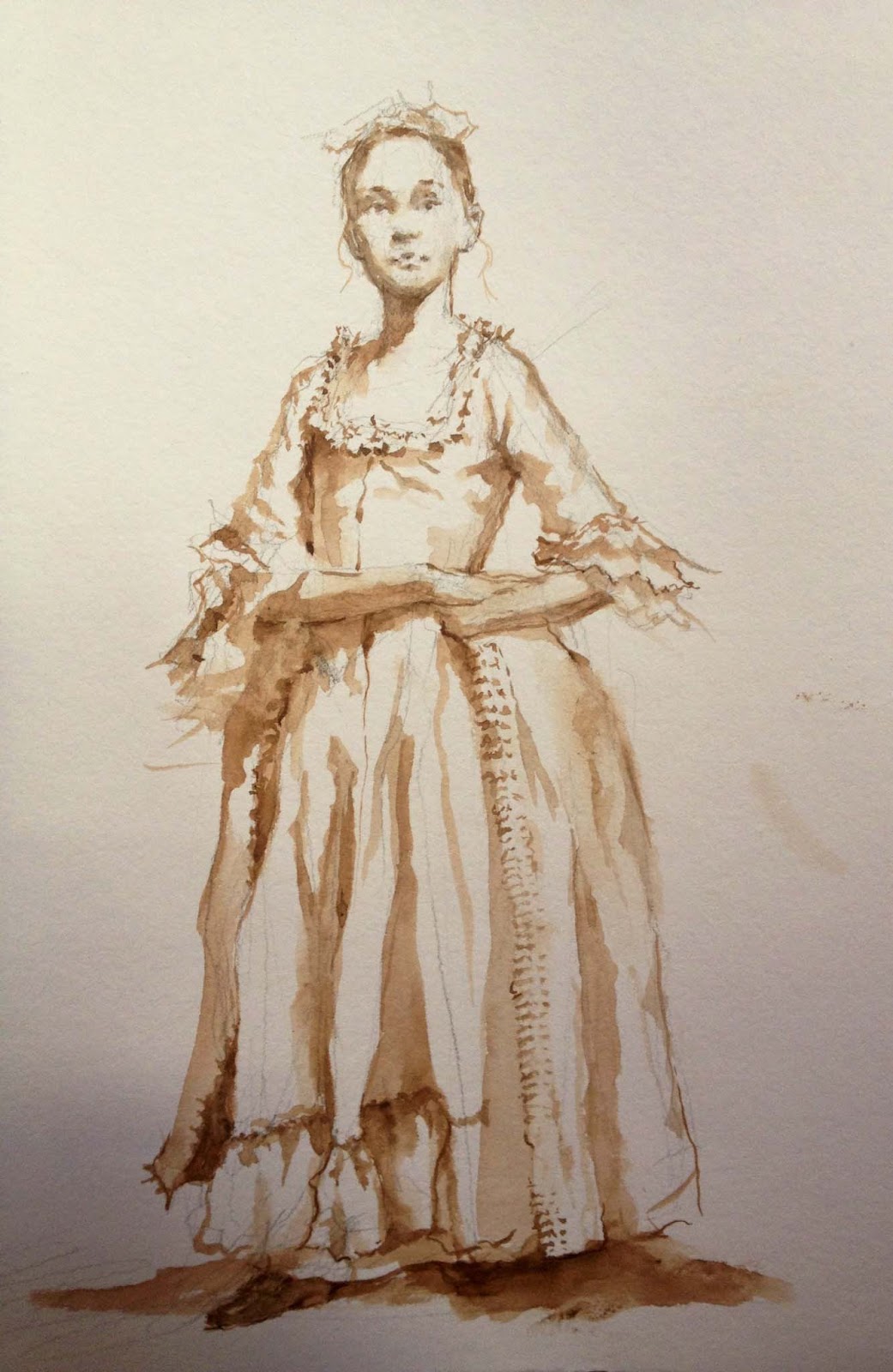
                         Watercolor wash painting of Lily by Robert Liberace.

As Liberace builds up the form he is conscious of not over working the dress, he wants to keep the image fresh and fluid.  He lets the white of the paper show through as the highlights and lighter values. he uses dark accents to describe areas of shadow.  The fluidity of his brushwork is remeniscent of Tiepolo. The figure’s dress and pose recall Rococo artists such as Watteau and Fragonard.

                                      Sam Dunlap posing as a buccaneer.

For the watercolor portrait of Sam, as a buccaneer, Liberace started with a light graphite sketch and progressed to blocking in the flat areas of color with light washes.  As he worked he carefully observed the model and the nuances of light, shadow and color temperature.  The resulting portrait is a sensitive study, done with a confident and energetic brushwork, that captures the character of the sitter.


                      Watercolor wash portrait of Sam by Robert Liberace.

Monday, February 11, 2013

"Durer to de Kooning" Master Drawings at the Morgan Library


It was a pleasure to view the “Durer to de Kooning, 100 Master Drawings from Munich” exhibition at the Morgan Library in New York.  The Morgan is a wonderful, intimate museum and often features master drawings exhibitions.

Those of you who follow my blog known I have a passionate interest in master drawings.  I enjoy looking, studying and copying them.  I enjoy using master drawings techniques in my work. Since I have been using pen, ink and wash, charcoal, and red chalk as of late I decided to focus on drawings in the exhibition that utilize these materials.

All the drawings in this exhibition were truly masterful and compelling in their own way.  The ones I was most attracted to were done in a rapid visualization style and showcase an energetic rather than meticulous style.   Jacopo Pontormo’s (1494-1557) red chalk drawing Two Standing Women, (1530) is stunning for its sense of animation and confident three dimensional rendering.  I love the way Pontormo suggests the fluidity of the gowns without over rendering.  This short hand of line allows the viewer to wonder and speculate about who these women are.

                 Red chalk drawing Two Standing Women by Jacopo Pontormo, 1530.

Pietro da Cortona (1596-1669), whose anatomical drawings I have long admired, surprised me with this dynamic pen and ink and wash portrayal of Age of Bronze: Design for a Mural in the Pitti Palace, (1641). As you can see from the finished fresco, Cortona worked out many of the compositional elements in this initial sketch.  A pentimento by Cortona can be seen in the upper right hand corner.

                       Pen and ink drawing Age of Bronze by Pietro da Cortona, 1641.

                            Fresco Age of Bronze by Pietro da Cortona, 1641.

Rembrandt’s (1606-1669) pen, ink and brush drawings have an energy mirrored by his brushstrokes and layering of paint!  In his rapid sketch Saskia Lying in Bed, A Woman at Her Feet (1638) the focus is on Saskia (Rembrandt's wife) and her contemplative facial expression.  She is drawn with delicate, decisive pen lines, while the bedroom and maid are loosely described with swift brushstrokes.

 Pen, ink and brush drawing, Saskia Lying in Bed, A Woman at Her Feet by Rembrandt, 1638. 

The pen and ink drawing Adoration of the Magi (1610) by Jacques Bellange (1575-1616) displays lively networks of hatched and crosshatched lines, which draw the viewer’s eye around this forceful drawing! 

         Pen and ink drawing, Adoration of the Magi by Jacques Bellange, 1610.

I wish I could share all 100 drawings with you!  I highly recommend the exhibition catalog by William M. Griswold and Michael Semff. And an excursion to the Morgan Library, always a delight!

Monday, January 21, 2013

"Bernini Sculpting in Clay" at the Metropolitan Museum of Art


“You need to draw using your eye-that is, imprint everything in your mind-and always make sketches and drawings of your different ideas…”

So said sculptor and architect Gian Lorenzo Bernini (1598-1680) in 1673.  Bernini is best known for his dramatic sculptures that adorn his native city of Rome. Bernini is credited with starting the Baroque movement in sculpture, a hallmark of which is his masterpiece “Ecstasy of Saint Theresa”created in 1652.  This piece can be viewed in the Cornaro Chapel, in the church Santa Maria della Vittoria, Rome.

                   "Ecstasy of St. Theresa", 1652, Santa Maria della Vittoria, Rome.

When you see Bernini’s theatrical and life like sculptures it is natural to wonder what his process was. In December I saw a comprehensive exhibition that shed light on the way Bernini worked.  The exhibition was “Bernini Sculpting inClay” at the Metropolitan Museum of Art and it featured 39 terracotta models, or “three-dimensional sketches”, created by the the master.  These small clay models are bold, expressive and animated. Numerous drawings accompany the models and aid in understanding Bernini’s thought process.

                         Terracotta bozetto for "Ecstasy of St. Theresa", 1647-1652.

One of the most impressive “bozettos” in the show is a lion modeled for the “Fountain of Four Rivers” (1651) in Piazza Navona in Rome.  As Bernini suggests in the above quote he modeled the lion from his "mind’s eye", a naturalistic lion exaggerated in its anatomy and expression!

              Terracotta bozetto for the Lion on the "Fountain of Four Rivers", 1649-1650.

The largest terracotta in the show is a bozetto for the “Fountain of the Moor”, 1655, Piazza Navona, Rome. This dramatic, twisting piece embodies the energy of the figure and highlights Bernini’s way of describing textures-muscle, skin, hair, shell, dolphin and scales.  

                          Terracotta bozetto for "Fountain of the Moor" 1653.

It has been suggested that Bernini made 1000s of these terracotta sculptures, however not considering them finished works of art, but rather ‘sketches” he didn’t preserve them.  Only 52 remain intact.

For more info on Bernini’s life view this video from the Simon Schama BBC series “The Power of Art”.
http://www.youtube.com/watch?v=95_7l87prmI

I recommend the exhibition catalog "Bernini Sculpting in Clay" by C.D. Dickerson, III, Anthony Sigel and Ian Wardropper.

Sunday, December 2, 2012

Durer and Beyond, Central European Drawings, 1400-1700


In August while at the Metropolitan Museum of Art I saw two amazing drawings exhibitions.  One, which I blogged about last week, featured the plant drawings of minimalist Ellsworth Kelly.  These drawings were so beautiful and elegant for their simple use of line and negative and positive shape.

The “Durer and Beyond” exhibition featured many drawings also created with line.  Albrecht Durer’s energetic ink lines with layers of hatching and crosshatching were a great contrast to the Kelly drawings!

Albrecht Durer, (1471-1528) of Nuremberg, Germany, is regarded as the greatest artist of the Northern Renaissance.  While still in his twenties Durer became famous for his woodcuts, such as “Four Horsemen of the Apocalypse”.  He went on to create many masterful paintings, but his drawings are among his most famous works.  Amid his most revered pieces are “The Great Piece of Tuft”, “The Praying Hands” and “Wing of a Roller”  Many of these drawings are in the Albertina in Vienna.

          Albrecht Durer, pen and ink on prepared paper, "The Praying Hands", 1508

                      Albrecht Durer, watercolor and gouache, "Wing of a Roller", 1518

Throughout his life Durer was known for his detailed and complex self-portraits.  The exhibition drawing below “Self Portrait and Studies of the Artist’s Left Hand and a Pillow” features such a self-portrait with it’s penetrating gaze.  On the verso of this drawing is a series of whimsical drawings of a pillow.  The series almost reads like an animation!

Albrecht Durer, pen and ink, "Self Portrait and Studies of the Artist's Left Hand and a Pillow", 1493

                              Albrecht Durer, pen and ink, "Six Studies of a Pillow", 1493

The exhibition featured 100 drawings created between 1400-1700 by artists from Germany, Austria, Switzerland, Czech Republic among others.  A charming study of a hedgehog by Hans Hoffman (1530-1592) created with watercolor and gouache, highlights this artist’s love of observing nature down to the smallest detail!

                          Hans Hoffman, watercolor and gouache drawing of a hedgehog, 1584

If you enjoy looking at master drawings there are two current exhibitions that you might want to visit.  "The Mantegna to Matisse” exhibition at the Frick Collection, will be up through January 27, 2013 and the “Durer to de Kooning: 100 Master Drawings from Munich” is on view through January 6, 2013 at the Morgan Library.  I plan on blogging about both these exhibitions.


Monday, November 28, 2011

Master Drawing Exhibition at the Morgan Library

I recently had the pleasure of seeing an amazing master drawing exhibition at the Morgan Library in New York. For many years the Morgan has been one of my favorite NYC haunts. Over the years it has been renovated and expanded, but it still has a feeling of intimacy. The exhibition is "David, Delacroix, and Revolutionary France, Drawings from the Louvre" and can be viewed at the Morgan through December 31, 2011.

This exhibition features the works of many talented french artists, but for me the main attraction was the drawings by romanticist Theordore Gericault. Gericault is perhaps best know for his masterpiece the "Raft of the Medusa" and the beautiful but, macabre studies he did for this painting, many of them featuring lifeless limbs and heads arranged as still life.

There are six drawings by Gericault in this exhibition. A very beautiful and especially moving one is called "The Artist's Left Hand". Gericault painted it while on his death bed.

Gericault hand

"The Artist's Left Hand" watercolor with black and red chalk, Theordore Gericault, 1824.

The following drawing by Gericault, "Scene of Combat" shows off his brilliant use of chiaroscuro and romanticist sensibility.

Battle

"Scene of Combat", black chalk and gray wash, heightened with gouache on brown paper, Theordore Gericault, 1818.

Gericault was interested in depicting all animals - their motion and expression. While he is known for his masterful drawings and paintings of horses, this sketchbook sheet depicting a cat is beautifully observed!

cats

"Studies of Cats", black chalk, Theordore Gericault, 1818.

There are of course many amazing drawings in this exhibition. Some of those by Eugene Delacroix with their frentic line have an especially modern feeling.

Delacroix

"War on a Chariot Pulled by Two Horses", pen and brown ink, Eugene Delacroix, 1833.

There are several luminous classical figure studies by Pierre-Paul Prud'hon who was known for his black and white chalk drawings on toned paper.

Prudhon

"Standing Female Nude Resting Her Arms on a Branch", black and white chalk on blue paper,Pierre-Paul Prud'hon.

The extraordinary draftsman Jean-Auguste Dominique Ingres is presented in the exhibition by this animated study for the painting "The Turkish Bath". The exhibition is worth seeing if only to enjoy the facile and sensitive way Ingres draws the hands.

Ingres

"Studies for the Turkish Bath", graphite on cream paper,Ingres.

I highly recommend this exhibition, I promise you won't be disappointed in this spectacular display of french drawings. I also recommend the exhibition catalog, "David, Dealcroix and Revolutionary France" by Louis-Antoine Prat and Jennifer Tonkovich.