Showing posts with label Morgan library. Show all posts

Monday, February 25, 2013

Painting on Paper, Josef Albers in America


“Color is fooling us all the time”, so said color theorist and painter extraordinaire Josef Albers.  Josef Albers (1888-1976) a German painter, who taught at the Bauhaus, is best known for this minimalist paintings, advances in art education and influence in the study of color theory.

      Color study for Homage to the Square by Josef Albers , oil on paper, date unknown.

In September I had the pleasure of attending an exhibition of Albers’ works on paper at the Morgan Library in New York.  The show was  intriguing in that it featured eighty of Albers’ works on paper.  His working sketches if you will.  They offered insight into his process of his signature style geometric painting.

  Color study for Homage to the Square by Josef Albers , oil on paper, date unknown.

Josef Albers had a stellar career in art education transforming ideas on color theory. He taught at the Bauhaus, from 1923-1933, with such luminaries as Wassily Kandinsky, Oskar Schlemmer and Paul Klee, under the direction of Walter Gropius. In 1933 he emigrated to the United States and became director at the Black Mountain College in North Carolina, where his students included Robert Rauschenberg and Cy Twombly.  Finally in 1950 he landed at Yale University for the duration of his career. This is where he would spend the next 25 years experimenting with color and his geometric paintings.
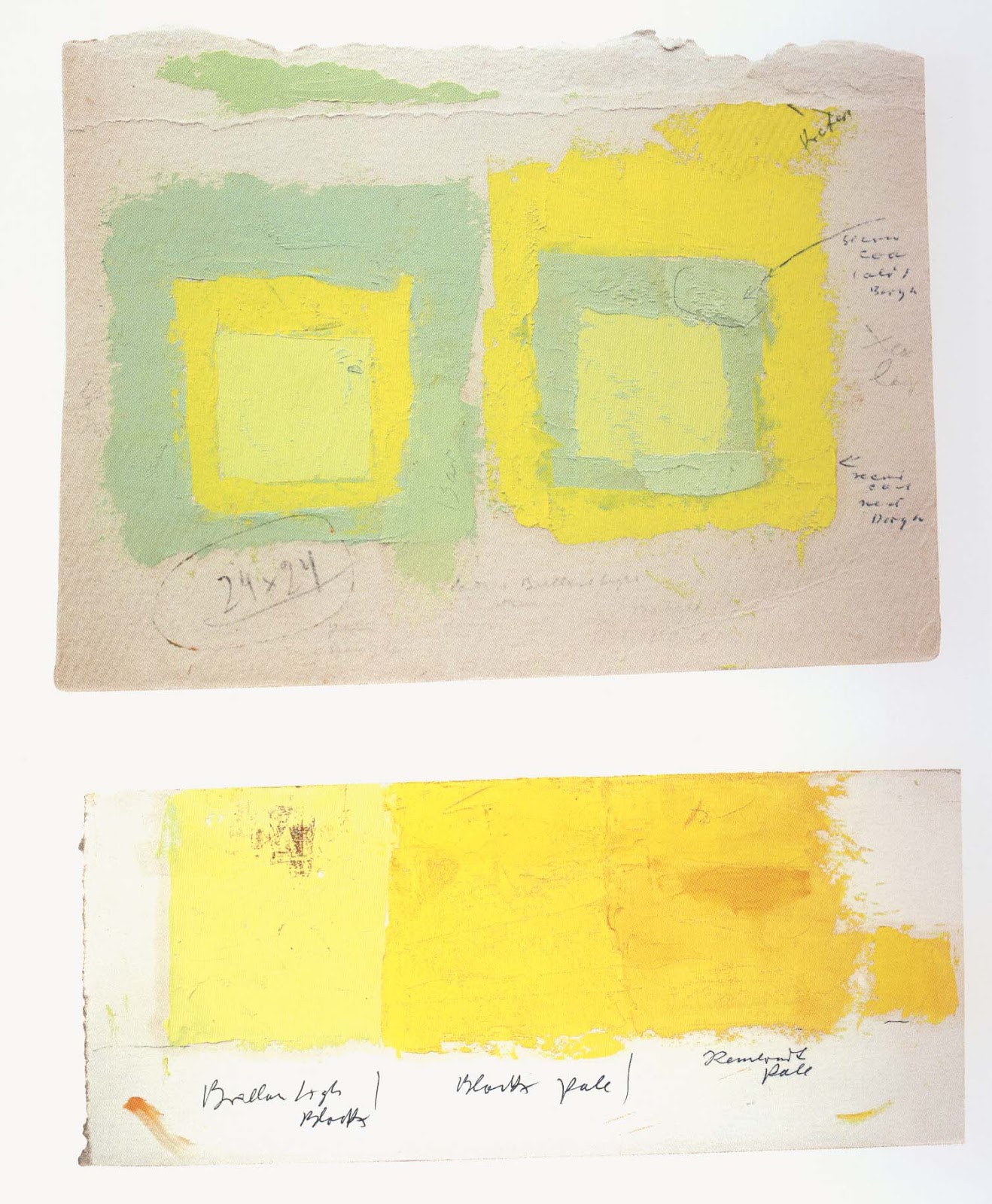
 Color study for Homage to the Square by Josef Albers , oil on paper, date unknown.

Albers is best known for his abstract painting of overlapping squares featuring color harmonies.  He never mixed his colors, but rather used color directly from the tube applied carefully with a palette knife.  His small scale, hard edge, symmetrical compositions were a response to the large and gestural works of the abstract expressionists and he would go on to influence movements such as minimalism and op art.

Color study for Homage to the Square by Josef Albers , oil on paper, date unknown.

From 1950 until 1976 Albers focused on his homage to the square or as he said “I am not paying “homage to the square”.   It’s only the dish I serve my craziness about color in”.

 Color study for Homage to the Square by Josef Albers , oil on paper, date unknown.

Indeed Albers was not crazy, but methodical in his observations on color harmonies.  He noted on each piece what colors he used and what manufacturer made the paint, he annotated his use of varnish and other medium  “I am not an acrobat in my painting.  I am a cook”.


                  Josef Albers, oil on canvas, Hirschhorn Museum, date unknown.

The catalog for this exhibition “Painting on Paper, JosefAlbers in America” includes a few fascinating essays by Heinz Liesbroc, Michael Semff and Isabelle Dervaux.


Monday, February 11, 2013

"Durer to de Kooning" Master Drawings at the Morgan Library


It was a pleasure to view the “Durer to de Kooning, 100 Master Drawings from Munich” exhibition at the Morgan Library in New York.  The Morgan is a wonderful, intimate museum and often features master drawings exhibitions.

Those of you who follow my blog known I have a passionate interest in master drawings.  I enjoy looking, studying and copying them.  I enjoy using master drawings techniques in my work. Since I have been using pen, ink and wash, charcoal, and red chalk as of late I decided to focus on drawings in the exhibition that utilize these materials.

All the drawings in this exhibition were truly masterful and compelling in their own way.  The ones I was most attracted to were done in a rapid visualization style and showcase an energetic rather than meticulous style.   Jacopo Pontormo’s (1494-1557) red chalk drawing Two Standing Women, (1530) is stunning for its sense of animation and confident three dimensional rendering.  I love the way Pontormo suggests the fluidity of the gowns without over rendering.  This short hand of line allows the viewer to wonder and speculate about who these women are.

                 Red chalk drawing Two Standing Women by Jacopo Pontormo, 1530.

Pietro da Cortona (1596-1669), whose anatomical drawings I have long admired, surprised me with this dynamic pen and ink and wash portrayal of Age of Bronze: Design for a Mural in the Pitti Palace, (1641). As you can see from the finished fresco, Cortona worked out many of the compositional elements in this initial sketch.  A pentimento by Cortona can be seen in the upper right hand corner.

                       Pen and ink drawing Age of Bronze by Pietro da Cortona, 1641.

                            Fresco Age of Bronze by Pietro da Cortona, 1641.

Rembrandt’s (1606-1669) pen, ink and brush drawings have an energy mirrored by his brushstrokes and layering of paint!  In his rapid sketch Saskia Lying in Bed, A Woman at Her Feet (1638) the focus is on Saskia (Rembrandt's wife) and her contemplative facial expression.  She is drawn with delicate, decisive pen lines, while the bedroom and maid are loosely described with swift brushstrokes.

 Pen, ink and brush drawing, Saskia Lying in Bed, A Woman at Her Feet by Rembrandt, 1638. 

The pen and ink drawing Adoration of the Magi (1610) by Jacques Bellange (1575-1616) displays lively networks of hatched and crosshatched lines, which draw the viewer’s eye around this forceful drawing! 

         Pen and ink drawing, Adoration of the Magi by Jacques Bellange, 1610.

I wish I could share all 100 drawings with you!  I highly recommend the exhibition catalog by William M. Griswold and Michael Semff. And an excursion to the Morgan Library, always a delight!

Monday, January 7, 2013

"Beatrix Potter, the Picture Letters" at the Morgan Library


Beatrix Potter (1866-1943) is known to many as the creator of The Tale of Peter Rabbit and many other children’s stories. What may not be know is that Beatrix Potter was an accomplished scientific illustrator and an astute businesswoman.  Both of these attributes added to her success as a children’s book author and illustrator.

                          Beatrix Potter and her pet rabbit "Benjamin Bouncer" 

Beatrix Potter was born in London in 1866 into an affluent family.  She enjoyed time at her family’s city home and in the countryside.  Beatrix and her brother Bertram had a menargie that included mice, rabbits and a hedgehog.  When the family travelled to the countryside Beatrix was fascinated with her natural surroundings and explored them through drawing.

                        Beatrix Potter's watercolor drawing of "Boar Fish", 1895.

   Beatrix Potter watercolor and pen and ink drawing of "Studies of a Dead Thrush", 1902.

The “Beatrix Potter, The Picture Letters” exhibition at the Morgan Library in New York is a must see for any Potter enthusiast.  The show focuses on Beatrix Potter’s many beautifully illustrated letters she wrote to children.  She corresponded with over forty children including her former governesses’ family.  Perhaps her most important correspondence was with young Noel Moore for whom she wrote the Tale of Peter Rabbit complete with lively pen and ink drawings.  The model for Peter was Beatrix Potter’s own pet rabbit that she described as “An affectionate companion and quite friend.”

                           Beatrix Potter's sketches of her pet rabbit Peter, 1899.

Beatrix attributed her success to the fact that her stories were written for “real children"- indeed a particular child.  Her studies of animals from life and scientific investigation of mushrooms, plants and landscape add an unusual freshness to her illustrations.  The animals are not mawkish or oversentimental.  Her animal characters keep a sense of the animal they are drawn from.

         Beatrix Potter's illustrated letter "Peter's Dream of a Comfortable Bed" 1899.

The exhibition includes early board games, stuffed animals and figurines based on the various Potter stories, ever the businesswoman Potter kept copyright and control of her famous characters.

            Beatrix Potter's watercolor and pen and ink drawing "His mother put him to bed, 
            and made some camomille tea", 1907.

I highly recommend a visit to the Morgan Library to enjoy this delightful exhibition!

Wednesday, January 2, 2013

Topics for 2013


Happy New Year!  As we begin the new year I have been brainstorming about blogging topics for 2013.  I was in New York for a few days and I plan on blogging about some amazing exhibitions I saw and plan on visiting.  Among them are the “Bernini, Sculpting in Clay” and “Matisse: True Painting” at the Metropolitan Museum of Art

Bernini's terracotta sculpture model for the "Lion on Four Rivers Fountain" 1649-50. From the  exhibition at the Metropolitan Museum of Art.


The “Beatrix Potter, The Picture Letters” and “Durer to de Kooning” exhibitions at the Morgan Library are worth discussion and exploration.  The Frick’s “Mantegna to Matisse, Master Drawings from the Courtauld Gallery” and MoMA’s “Inventing Abstraction” look fascinating.  The National Gallery of Art’s upcoming French drawing exhibition “Color, Line, Light: French Drawings, Watercolors, and Pastels from Delacroix to Signac” is much anticipated for it’s varied collection.

Pastel drawing by Auguste Louis Lepere, 1900.  From exhibition "Color, Line, Light: French Drawings from Delacroix to Signac" at the National Gallery of Art.


 I plan on continuing to blog about master drawing techniques , such as pen and ink and wash and red chalk.  As I prepare my 2014 Vesalius Trust“Art and Anatomy” tour to Greece and Italy I will continue to blog about Andreas Vesalius whose 500th anniversary is next year! To reflect the focus of my blog I have added "Art and Anatomy" to my title.

Pen and ink drawing by Jacques Bellange, 1610. From the "Durer to de Kooning" exhibition at the Morgan Library.


Thanks for reading, commenting and joining me on my art and anatomy travels!